

🌿 Ready to Tackle Stress from Every Angle?
Better sleep and sharper mental focus can transform how your body handles daily stress. Explore our two top recommended wellness tools below.
💡 Quick Summary: Stress affects millions of people worldwide — but most people never learn how to manage it properly. This beginner’s guide breaks down the most effective, science-backed strategies to reduce stress naturally, improve your sleep, and sharpen your mental clarity — step by step.
You wake up exhausted. Your to-do list feels endless. Your mind won’t stop racing — even at 2 AM.
If that sounds familiar, you’re not broken. You’re just overwhelmed — and your body is sending a very clear signal that something needs to change.
The good news? Stress management doesn’t have to be complicated. In fact, the most effective techniques are surprisingly simple — and you can start today, even if you’ve never tried anything like this before.
This guide was written specifically for beginners. No jargon. No complicated routines. Just real, practical tools to help you feel calmer, sleep better, and reclaim control of your life.
77%
of people report physical symptoms caused by stress
55%
of Americans feel stressed during the day
1 in 3
adults sleep less than 7 hours due to stress
What Is Stress — and Why Does It Feel So Overwhelming?
Before we can manage stress, we need to understand it. Stress is your body’s natural response to pressure, challenge, or danger. It’s actually designed to protect you — it’s what kept our ancestors alive.
But here’s the problem: modern life keeps that alarm system constantly switched on, even when there’s no real danger. Work deadlines, social media, financial pressure, relationship problems — your brain treats all of these as “threats.”
Over time, this leads to what experts call chronic stress — and it can seriously damage your physical and mental health.
Common Signs You're Living with Too Much Stress
- Constant fatigue, even after sleeping
- Trouble concentrating or remembering things
- Frequent headaches or muscle tension
- Feeling irritable, anxious, or "on edge"
- Digestive issues like bloating or stomach aches
- Disrupted sleep — difficulty falling or staying asleep
- Low motivation and difficulty making decisions
Important
If stress is significantly affecting your daily life, please consider speaking with a qualified mental health professional. This article is for informational purposes and is not a substitute for medical advice.
The Beginner's Stress Management Roadmap
There’s no single “cure” for stress — but there is a proven framework that works for beginners. Think of it as four pillars that work together:
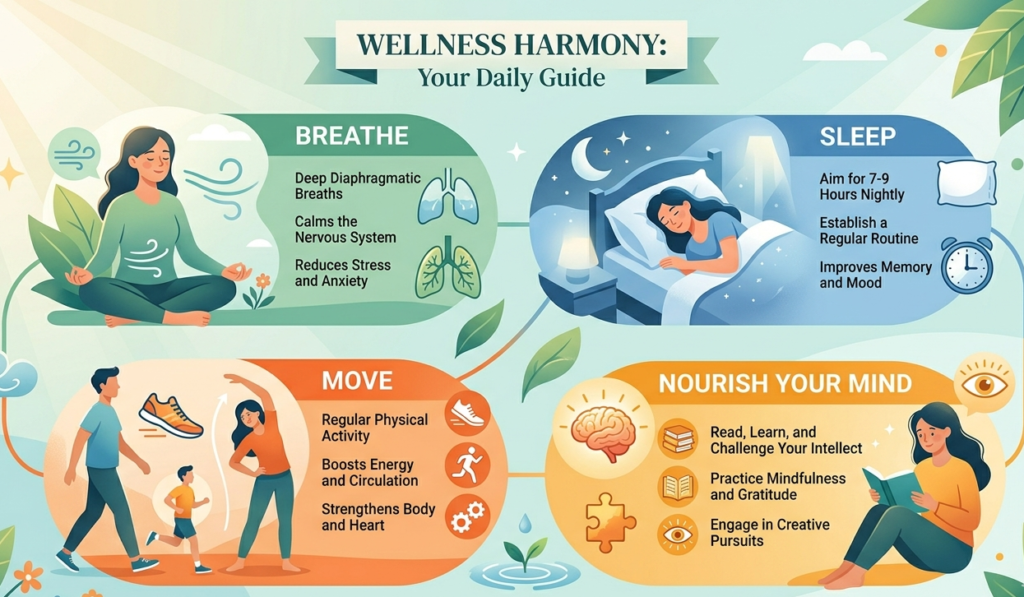
🌬️ Breathe — Calm your nervous system immediately
Your breath is the fastest, most accessible tool you have. The right breathing techniques can shift your body from “fight or flight” to “rest and digest” in minutes.
😴 Sleep — Restore and recover every night
Without quality sleep, stress management is nearly impossible. Sleep is when your brain processes emotions and your body repairs itself.
🏃 Move — Release stored tension from your body
Exercise is one of the most powerful natural stress relievers available. Even a 20-minute walk can significantly lower cortisol levels.
🧠 Nourish Your Mind — Support mental clarity from within
What you put in your body directly affects how your brain handles stress. The right nutrients and supplements can make a noticeable difference.
Pillar 1 — Breathe: Quick Techniques to Calm Anxiety Fast
When stress hits, your breathing becomes shallow and fast — which actually amplifies anxiety. Deep, intentional breathing does the opposite: it activates your parasympathetic nervous system and tells your brain “you’re safe.”
3 Breathing Exercises Perfect for Beginners
1. Box Breathing (4-4-4-4)
- Inhale for 4 seconds
- Hold for 4 seconds
- Exhale for 4 seconds
- Hold for 4 seconds
- Repeat 4–6 times — used by Navy SEALs and high-performance athletes
2. The 4-7-8 Technique
- Inhale through your nose for 4 seconds
- Hold your breath for 7 seconds
- Exhale completely through your mouth for 8 seconds
- Especially effective before bed to calm a racing mind
3. Diaphragmatic (Belly) Breathing
- Place one hand on your chest, one on your belly
- Breathe so only your belly rises (not your chest)
- Do this for 5 minutes whenever you feel overwhelmed
💡 Pro Tip
Set a reminder on your phone to practice one of these techniques at least twice a day — once in the morning and once before bed. Consistency is more important than duration.
Pillar 2 — Sleep: Why Rest Is Your Most Powerful Stress Reset

Here’s something most people don’t realize: stress and sleep deprivation are locked in a vicious cycle.
Stress makes it harder to sleep. And poor sleep makes your body even more reactive to stress the next day. It’s a loop that exhausts you physically and mentally — until you break it.
Science-Backed Sleep Hygiene Tips for Beginners
- Keep a consistent sleep schedule — even on weekends
- Avoid screens 60 minutes before bed — blue light suppresses melatonin
- Keep your bedroom cool — 65–68°F (18–20°C) is optimal for sleep
- Avoid caffeine after 2 PM — it has a half-life of 5–7 hours
- Create a wind-down routine — reading, light stretching, or journaling signals sleep is near
- Limit alcohol — it disrupts REM sleep and increases cortisol
When Sleep Feels Impossible — Consider Natural Support
Sometimes good habits alone aren’t enough — especially when chronic stress has disrupted your natural sleep cycles. That’s where targeted, natural sleep support can make a meaningful difference.
Sleep Lean
Sleep is one of the most important — and most overlooked — factors in stress management and overall wellness. Sleep Lean is formulated to support deeper, more restorative sleep cycles, helping your body and mind genuinely recover each night.
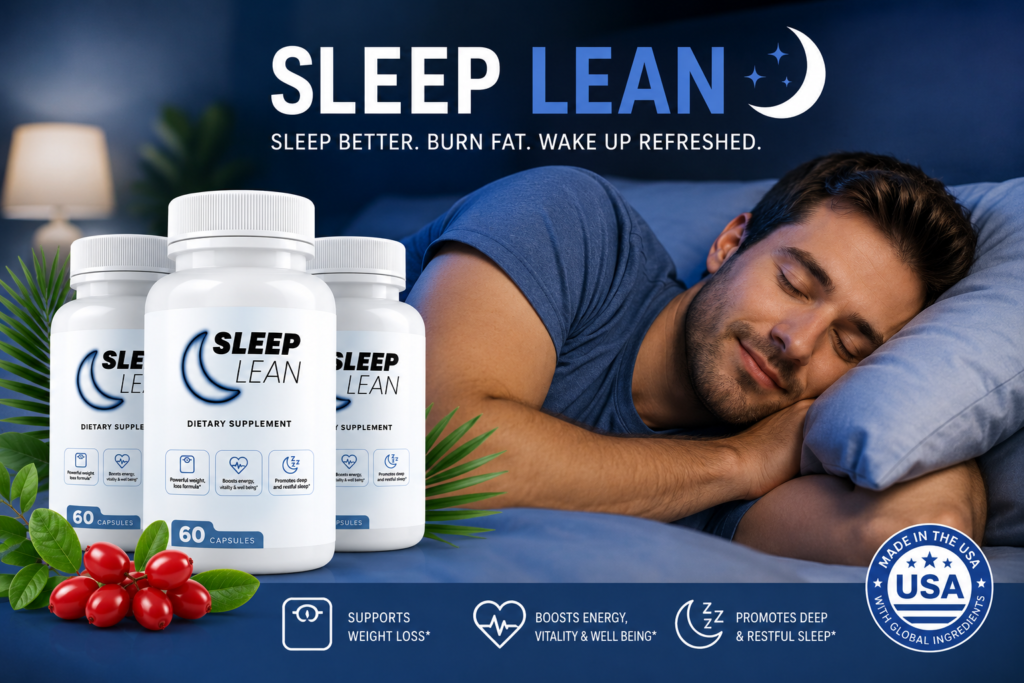
What Sleep Lean May Support:
- Deeper, more restorative sleep cycles
- Relaxation and reduced nighttime restlessness
- Waking up feeling refreshed — not groggy
- Reduced bloating and improved body confidence
- Natural fat-burning processes that happen during deep sleep

Pillar 3 — Move: How Exercise Melts Stress Away
You don’t need to run a marathon. You don’t need a gym membership. You just need to move your body.
Exercise triggers the release of endorphins — your brain’s natural feel-good chemicals. It also lowers cortisol (the primary stress hormone) and improves sleep quality. It’s one of the most well-researched natural antidepressants in existence.
Best Beginner-Friendly Exercises for Stress Relief
| Exercise | Duration | Stress Relief Level |
|---|---|---|
| 🚶 Brisk Walking | 20–30 min | ⭐⭐⭐⭐ |
| 🧘 Yoga | 20–45 min | ⭐⭐⭐⭐⭐ |
| 🏊 Swimming | 30 min | ⭐⭐⭐⭐⭐ |
| 🚴 Cycling | 20–40 min | ⭐⭐⭐⭐ |
| 💃 Dancing | 15–30 min | ⭐⭐⭐⭐ |
| 🤸 Stretching | 10–15 min | ⭐⭐⭐ |
💡 Beginner Tip
Start with just 10 minutes a day of any movement you enjoy. You don’t need a perfect routine — you just need to start. Even a short walk around the block will lower your cortisol levels.
🌿 Ready to Tackle Stress from Every Angle?
Better sleep and sharper mental focus can transform how your body handles daily stress. Explore our two top recommended wellness tools below.
Pillar 4 — Nourish Your Mind: Mental Clarity Under Stress

Chronic stress doesn’t just make you feel anxious — it physically changes how your brain works.
Prolonged high cortisol impairs memory, reduces focus, and accelerates mental fatigue. Over time, it can lead to what many people call “brain fog” — that frustrating inability to think clearly or remember simple things.
Signs Stress Is Affecting Your Brain
- Difficulty concentrating on tasks you normally handle easily
- Forgetting things more frequently than usual
- Feeling mentally "drained" even after resting
- Slow, foggy thinking in the mornings
- Difficulty making even simple decisions
- Loss of motivation and creative thinking
Here’s the deeper mechanism: chronically elevated cortisol doesn’t just fog your thinking — it’s one of the primary drivers of insulin resistance, the metabolic root cause behind stubborn fatigue, cravings, and belly fat. See our full breakdown: What Is Insulin Resistance? Signs, Causes & Natural Ways to Fix It.
Nutrients That Support Brain Health Under Stress
- Omega-3 fatty acids — reduce neuroinflammation and support mood regulation
- Magnesium — depleted rapidly by chronic stress; essential for nerve function
- B vitamins — crucial for neurotransmitter production and energy metabolism
- Adaptogenic herbs — like Ashwagandha and Rhodiola that help the body regulate cortisol
- Antioxidants — protect brain cells from oxidative stress damage
Neuro Serge
Brain fog, low focus, and mental fatigue are increasingly common side effects of modern stress. Neuro Serge was developed to support cognitive performance, mental clarity, and overall brain wellness — naturally, without harsh stimulants.

What Neuro Serge May Support:
- Cognitive function and mental clarity
- Natural mental energy — without jitters or crashes
- Healthy brain aging and antioxidant protection
- Blood circulation for better oxygen delivery to the brain
- Non-GMO · Gluten Free · Non-Habit Forming · No Harsh Stimulants

Building Your First Stress Management Routine
The most important thing to remember? Small, consistent habits beat perfect routines every time.
Here’s a simple, realistic daily routine for beginners:
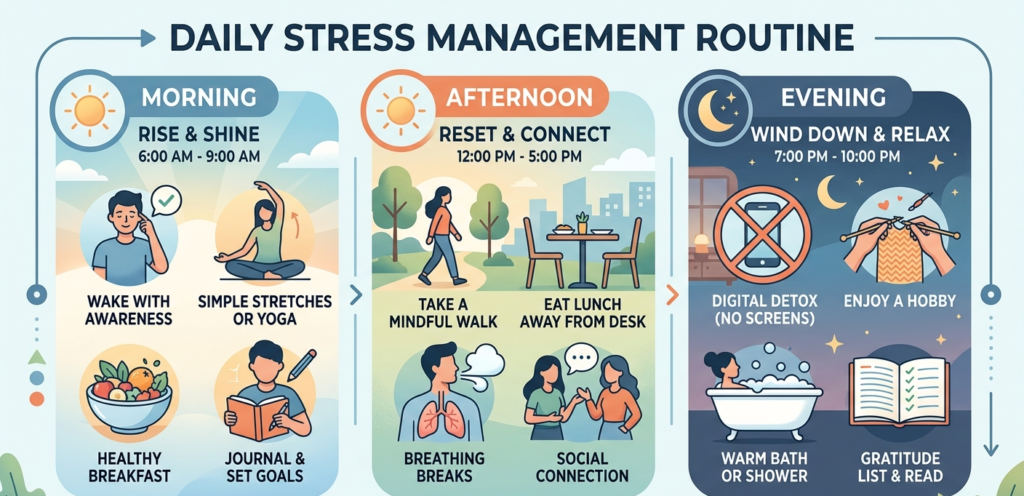
🌅 Morning (10 minutes)
- Wake at the same time each day (no snooze button)
- Drink a glass of water before coffee
- 5 minutes of box breathing or journaling
- Write down 3 things you’re grateful for
☀️ Afternoon (5–10 minutes)
- Take a short walk outside (even 10 minutes is powerful)
- Do a 5-minute breathing reset between tasks
- Eat a nutritious lunch without screens if possible
🌙 Evening (15–20 minutes)
- Screens off 60 minutes before bed
- Light stretching or gentle yoga
- Journal your thoughts to “offload” the day
- Take your sleep support supplement if using one
- Practice 4-7-8 breathing as you get into bed
🎯 Beginner’s Rule
Don’t try to implement everything at once. Pick one habit from each time block and practice those for two weeks before adding more. Habits compound — the key is starting.
Frequently Asked Questions
Final Thoughts: Your Calm Life Starts with One Small Step
Stress management doesn’t require a radical life overhaul. It doesn’t demand hours of meditation, expensive retreats, or a perfect lifestyle.
It starts with one breath. One habit. One better night of sleep.
You’ve already taken the first step by reading this far. Now it’s time to put one thing into practice today — whether that’s a 5-minute breathing exercise before bed, a short morning walk, or giving your sleep the support it deserves.
Remember: your nervous system wants to heal. You just need to give it the right tools and a little consistency.

🌿 Support Your Stress Recovery from the Inside Out
Pair your new daily habits with targeted natural support — better sleep and sharper mental clarity can accelerate your progress.
Join our community  and get daily wellness tips delivered to your inbox